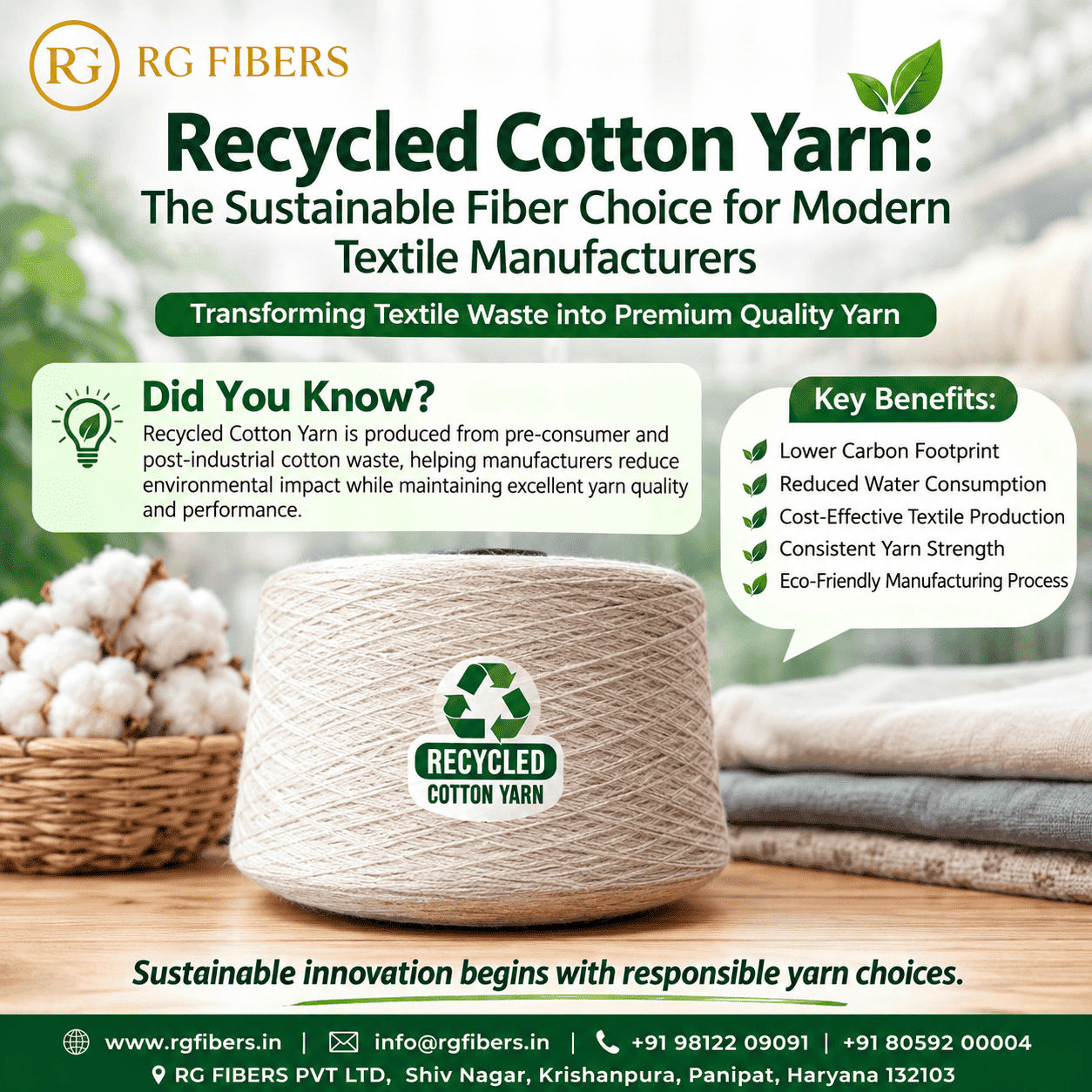
Recycled Cotton Yarn: The Sustainable Fiber Choice for Modern Textile Manufacturers
The global textile industry is going through a quiet revolution, and Recycled Cotton Yarn is right at the center of it. As brands, mills, and garment exporters look for ways to cut water usage, reduce carbon emissions, and meet international sustainability standards, recycled cotton has moved from a "nice-to-have" to a business necessity. If you are a buyer searching for a dependable, GRS-certified source of Recycled Cotton Yarn, this guide will walk you through everything you need to know — and introduce you to one of India's leading manufacturers, RG Fibers Private Limited, based in Panipat, Haryana.
What Exactly Is Recycled Cotton Yarn?
Recycled Cotton Yarn is spun from cotton fiber that has already lived a life — either as pre-consumer waste (offcuts and trimmings from garment factories) or post-consumer waste (old clothes, worn-out textiles, and end-of-life fabrics). Instead of sending this material to a landfill or an incinerator, manufacturers mechanically shred it back into raw fiber and re-spin it into fresh, usable yarn.
Unlike virgin cotton, which starts with farming, irrigation, ginning, and heavy pesticide use, Recycled Cotton Yarn skips all of that. The result is a fiber that saves enormous amounts of water, avoids new land use, and keeps textile waste out of the environment — all while still delivering the softness, strength, and versatility that cotton is loved for.
Why the Demand for Recycled Cotton Yarn Is Growing So Fast
A few years ago, "sustainable yarn" was a niche request. Today, it's a standard line item in sourcing briefs from apparel brands, home textile companies, and industrial fabric makers across the world. There are some clear reasons behind this shift:
- Water scarcity concerns — producing a single kilogram of conventional cotton can require thousands of liters of water, while recycled cotton bypasses the farming stage almost entirely.
- Stricter brand sustainability targets — many global retailers now require a percentage of recycled content in their supply chain.
- Rising landfill and textile-waste pressure — countries are tightening regulations around textile disposal, pushing manufacturers toward circular solutions.
- Consumer preference — shoppers increasingly favor products with a visible sustainability story, and recycled cotton fits that narrative perfectly.
This is exactly where a trusted Recycled Cotton Yarn manufacturer becomes valuable — not just as a supplier, but as a long-term sourcing partner.
RG Fibers: A Leading Recycled Cotton Yarn Manufacturer in Panipat
RG Fibers Private Limited has been manufacturing recycled yarn since 2019 from its base in Panipat, Haryana — a city often called India's textile recycling capital, where a large share of the country's recycled fiber is processed. The company operates from a 1,00,000 sq. ft. facility running 24×7 across three shifts, supported by more than 200 skilled professionals and 13 Open-End spinning machines.
Every month, the facility produces around 1,000 metric tons of recycled yarn, making it one of the higher-capacity players in the segment. For buyers, this scale matters — it means large, repeat, and export orders can be fulfilled reliably without production bottlenecks.
You can explore the full product specification sheet directly on their dedicated product page: Recycled Cotton Yarn by RG Fibers.
How RG Fibers Manufactures Recycled Cotton Yarn
The production process is fully mechanical and largely chemical-free, which keeps the environmental footprint low at every stage:
- Waste Collection – Pre-industrial offcuts and post-consumer cotton garments are sourced from verified textile mills and collection centers around Panipat, Delhi NCR, and Ludhiana.
- Sorting & Color Grading – Waste is manually sorted by fiber type and color family. This step is what allows the company to offer natural mélange shades without extra dyeing.
- Shredding & Garnetting – Fabric is mechanically broken down into individual fiber strands using high-speed opening machines, with no harsh chemical treatment involved.
- Blending & Carding – Recovered fibers are blended in precise ratios and carded to align them, forming a smooth, uniform sliver.
- Open-End Spinning – The sliver is spun into finished yarn on Open-End machines, with counts customizable per client requirement across a range roughly between Ne 2s and Ne 20s (single and plied).
- Quality Testing & Packaging – Every production lot goes through tensile strength, count accuracy, and evenness testing before being packed into standard cones, hanks, or bulk bags.
Key Specifications of RG Fibers' Recycled Cotton Yarn
| Specification | Details |
|---|---|
| Fiber Source | Pre- and post-consumer cotton waste |
| Spinning System | Open-End (OE) and Ring spun options |
| Color Options | Natural mélange, raw white, custom-dyed |
| Packaging | Cones, hanks, and bulk bags (50 kg / 60 kg) |
| Certification | GRS, OEKO-TEX Standard 100, ISO 9001:2015 |
| Applications | Home textiles, apparel, denim, gloves, hosiery, blankets |
Where Is Recycled Cotton Yarn Used?
One of the biggest advantages of Recycled Cotton Yarn is how versatile it is across industries:
- Home Textiles — rugs, mops, wipers, and towels
- Apparel & Fashion — casual wear, denim, and upcycled fashion lines
- Industrial Products — knitted work gloves and safety textiles
- Knitwear — hand-knit and machine-knit products
- Hosiery — everyday and workwear socks
- Woven Fabrics — shirting and lining material
- Home Décor — recycled throws and blankets
Because the yarn is available across a wide count range, it can move comfortably between coarse industrial use and finer knitting or weaving applications.
Environmental Impact: Why Buyers Are Switching to Recycled Cotton
Cotton farming is one of the most water-intensive agricultural activities on the planet. By skipping the growing, irrigation, and ginning stages entirely, recycled cotton production can cut water usage by a significant margin compared to virgin cotton — while also lowering the carbon footprint associated with farming, transport, and chemical dyeing. For brands trying to hit ESG and sustainability targets, switching even a portion of their yarn sourcing to recycled cotton can make a measurable, reportable difference.
RG Fibers holds GRS (Global Recycled Standard) certification, which provides full chain-of-custody traceability — meaning buyers can verify exactly how much recycled content is in the yarn they're purchasing, and use that documentation to support their own sustainability claims and audits.
Frequently Asked Questions About Recycled Cotton Yarn
Is Recycled Cotton Yarn as strong as virgin cotton yarn? For coarser counts, recycled cotton yarn performs very well and is fully suitable for industrial, home textile, and apparel uses. At very fine counts, a small polyester blend is sometimes added to boost durability without compromising the eco-credentials of the yarn.
What is the minimum order quantity (MOQ)? MOQ typically depends on the count and specification required. RG Fibers accommodates both trial orders for new buyers and larger bulk contracts for established manufacturers.
Can the yarn be custom dyed? Yes — apart from natural mélange and raw white shades, custom-dyed options are available on request.
Does RG Fibers export Recycled Cotton Yarn? Yes, the company supplies buyers across India and exports to Nepal, handling full documentation including commercial invoices, packing lists, and certificates required for cross-border shipment.
Get in Touch for Recycled Cotton Yarn Supply
If you are sourcing Recycled Cotton Yarn for your mill, garment unit, or export business, RG Fibers Private Limited offers direct factory pricing, free samples, and full GRS documentation support.
- Website: www.rgfibers.in
- Product Page: Recycled Cotton Yarn
- Phone / WhatsApp: +91 98122 09091
- Email: info@rgfibers.in
- Factory & Corporate Office: Unit No. 4, Shiv Nagar, Krishanpura, Panipat, Haryana – 132103, India
Whether you need a single trial batch or a long-term monthly supply agreement, the team typically responds to enquiries within a few business hours with pricing, samples, and certification documents.